
How Smart SMEs Are Plugging Revenue Leaks Using Industry 4.0
- Jaykishan vansadawala
- Apr 6
- 5 min read

In the previous article, we explored a challenge many SME leaders quietly recognize.
Revenue rarely disappears suddenly.
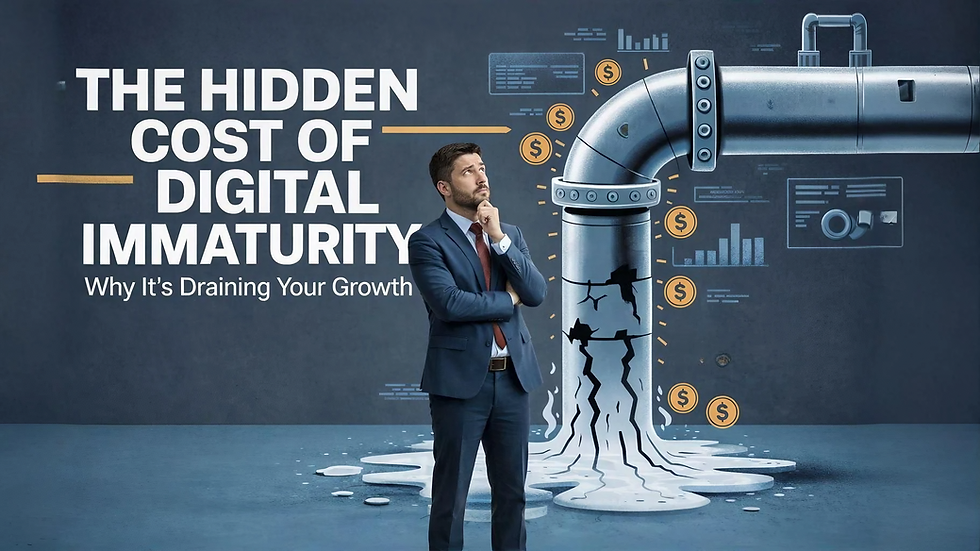
More often, it leaks slowly through everyday operational gaps - missed leads, idle inventory, unclear marketing ROI, fragmented data, and slow decision-making.
Many businesses try to solve this by increasing effort.
More marketing.
More sales activity.
More operational oversight.
Yet the real issue often lies elsewhere.
The problem is not effort.The problem is limited operational visibility and inefficient processes.
Forward-looking SMEs across industries are beginning to address this differently.
Instead of simply working harder, they are improving how their businesses detect, analyze, and respond to operational signals.
This is where Industry 4.0 technologies are quietly transforming SME operations - not as futuristic innovations, but as practical tools for protecting revenue and improving efficiency.
Executive Snapshot: How SMEs Are Fixing Revenue Leaks
Business Challenge | Traditional SME Approach | Industry 4.0 Approach | Result |
Lead follow-ups | Manual responses, delayed engagement | AI-powered sales automation | Higher conversion rates |
Inventory visibility | Periodic stock checks | IoT-based inventory monitoring | Reduced idle stock |
Business data | Scattered spreadsheets | Cloud-based dashboards | Faster decision-making |
Marketing engagement | Traditional campaigns | AR-driven product experiences | Better customer engagement |
Key insight:Smart SMEs are not simply adopting technology - they are using it to protect revenue, reduce operational waste, and improve decision speed.
The Shift Toward Intelligent Operations
Historically, many SMEs relied on manual processes such as spreadsheets, periodic reporting, and fragmented software tools.
While these approaches worked during early stages of growth, they create limitations as businesses scale.
Operational visibility decreases.Decisions become slower.Teams depend heavily on manual effort.
According to research from the World Economic Forum, businesses that integrate digital technologies significantly improve operational productivity and transparency compared to those relying on manual processes.
Industry 4.0 allows SMEs to move from reactive operations to intelligent operations.
The objective is not technology adoption for its own sake.
The objective is improving three critical business outcomes:
Revenue ↑Cost ↓Speed ↑
Let’s examine how SMEs are applying these technologies in practical ways.
AI for Sales Automation: Recovering Lost Leads
Lost leads represent one of the most common hidden revenue leaks in SMEs.
Customer inquiries arrive through websites, emails, or social channels, yet responses are delayed due to manual processes.
Artificial Intelligence is helping SMEs automate early stages of the sales cycle.
AI-driven sales tools can:
Respond instantly to customer inquiries
Qualify prospects automatically
Schedule follow-ups without manual effort
Prioritize high-value leads for sales teams
SME Example
A mid-sized manufacturing SME receives dozens of website inquiries every week.
Previously, responses depended on manual follow-ups by the sales team. Some prospects waited hours or even days for replies.
After introducing AI-powered automation:
Customer responses became immediate
Leads were categorized automatically
Sales teams focused on qualified prospects
The result:
Revenue ↑ through improved conversion rates
Cost ↓ through reduced manual workload
Speed ↑ through faster lead engagement
Research by McKinsey & Company shows that sales automation significantly improves productivity and lead conversion.
Cloud Platforms for Operational Visibility
Another major challenge SMEs face is fragmented operational data.
Sales, finance, inventory, and marketing information often exist in different tools or spreadsheets.
Without a unified view of performance, decision-making becomes slower and less accurate.
Cloud platforms address this challenge by centralizing business information.
With cloud-based systems, SMEs can:
Access real-time operational dashboards
Generate reports instantly
Collaborate across departments
Monitor performance from anywhere
According to insights from Gartner, organizations adopting cloud systems gain higher operational agility and faster decision-making capabilities.
For SME leaders, the benefits are immediate.
Revenue ↑ through faster opportunity identification
Cost ↓ by reducing manual reporting
Speed ↑ through real-time operational insights
IoT for Smarter Inventory Management
Inventory inefficiencies can quietly tie up significant working capital.
Many SMEs discover slow-moving inventory months after the problem emerges.
The Internet of Things (IoT) helps address this challenge by enabling real-time inventory tracking.
IoT systems allow businesses to:
Monitor stock levels continuously
Track product movement across warehouses
Detect slow-moving inventory earlier
Automate stock replenishment alerts
SME Example
A retail SME implemented IoT-based inventory sensors across its warehouse.
Previously, inventory checks happened manually every few weeks.
After IoT deployment:
inventory visibility became real-time
slow-moving products were identified earlier
procurement decisions improved
The business experienced:
Revenue ↑ due to better product availability
Cost ↓ through reduced excess inventory
Speed ↑ via automated stock monitoring
Studies by Deloitte highlight that IoT significantly improves supply chain visibility and inventory efficiency.
Augmented Reality for Measurable Marketing
Marketing effectiveness can be difficult to measure for many SMEs.
Campaigns may generate engagement but not always translate into sales.
Augmented Reality (AR) is helping businesses create more interactive and measurable marketing experiences.
AR enables customers to interact with products before purchasing.
Examples include:
visualizing furniture in real environments
interactive product demonstrations
immersive product exploration
Research published by Harvard Business Review indicates immersive technologies can significantly improve customer engagement and purchase confidence.
For SMEs, AR improves marketing outcomes by making customer interactions more measurable and engaging.
Revenue ↑ through improved purchase confidence
Cost ↓ by focusing marketing on high-impact experiences
Speed ↑ by helping customers evaluate products faster
Industry 4.0 Impact Summary for SMEs
Technology | Revenue Impact | Cost Impact | Speed Impact |
AI Sales Automation | Higher lead conversion | Reduced manual workload | Instant engagement |
Cloud Platforms | Faster opportunity identification | Lower reporting costs | Real-time insights |
IoT Inventory | Improved product availability | Reduced idle inventory | Automated monitoring |
AR Marketing | Higher customer confidence | More targeted campaigns | Faster buying decisions |
The Cost of Ignoring Operational Transformation
Some SMEs hesitate to adopt digital technologies due to perceived cost or complexity.
However, the larger risk often lies in maintaining inefficient processes.
Businesses that ignore operational modernization may face:
Slower decision-making
Reduced productivity
Limited scalability
Declining competitiveness
According to insights from the International Data Corporation, digitally mature organizations consistently outperform competitors in operational agility and efficiency.
For SMEs, the real cost is not technology investment.
The real cost is revenue lost through inefficiency.
Strategic Reflection for SME Leaders
Before launching new growth initiatives, consider asking:
How many customer inquiries remain unanswered each month?
How much working capital is tied up in slow-moving inventory?
How quickly can leadership access accurate operational data?
How measurable are current marketing campaigns?
Often, the opportunity for growth already exists within the business.
It simply requires greater operational visibility and smarter processes.
The Core Insight
Technology is not an expense.
It is revenue protection.
What Comes Next
Across industries, SMEs that improve operational visibility and automation are beginning to unlock faster growth and stronger competitiveness.
The journey toward Industry 4.0 does not require large-scale transformation overnight.
It begins with recognizing where inefficiencies exist and taking the first step toward smarter operations.


Nice
Our platform shares actionable content about implementing an AI agent for customer support to streamline workflows, reduce operational pressure, and improve customer satisfaction. We cover chatbot automation, AI communication trends, support optimization, and practical strategies businesses can use to scale customer interactions more efficiently.