
The 5 Levels of Digital Maturity for SMEs | A Practical Growth Framework

Many medium and small-sized businesses are stuck with poor processes, and increasing costs. Business owners want to expand to stay competitive and able to meet the demands of customers online, but are overwhelmed by the digital revolution.
Many SMEs believe digital maturity begins when software is implemented.
A CRM is purchased.
An ERP is introduced.
Accounting systems are digitized.
Marketing tools are activated.
This often creates the impression that transformation is already underway. But digital maturity is not defined by the number of tools a business owns. It is defined by how effectively technology improves decisions, efficiency, customer experience, and growth.
Every day brings new technologies like artificial intelligence machines, cloud computing, machine learning as well as smart phones. It can be difficult to know where to start. difficult.
Recent research shows that SMEs represent more than 100 percent of all businesses and play a significant part in the creation of jobs and exports. Yet, many are unsure of the best way to utilize technology to get greater outcomes. According to the Organisation for Economic Co-operation and Development, SMEs that integrate digital systems effectively tend to outperform peers in productivity, agility, and resilience.
The 5 stages of Digital Transformation for SMEs break the process down into simple steps with practical strategies that are seen by industry experts.
It is understanding where they currently stand and what the next stage should look like. That is why a maturity framework matters. This guide covers methods for evaluating including objective-setting techniques as well as strategy-planning advice.
Why Digital Maturity Matters for SMEs
For SMEs, growth often creates operational complexity. | More customers. |
More orders. | |
More data. | |
More processes. | |
Without digital maturity, this complexity becomes friction. | |
Common outcomes of low maturity | Slow decision-making |
Manual reporting overload | |
Data silos across teams | |
Inconsistent customer follow-up | |
Rising operational cost | |
Difficulty scaling profitably | |
Digital maturity helps convert complexity into control. | |
The 5 Levels of Digital Maturity
Below is a practical framework SMEs can use to assess their current position.
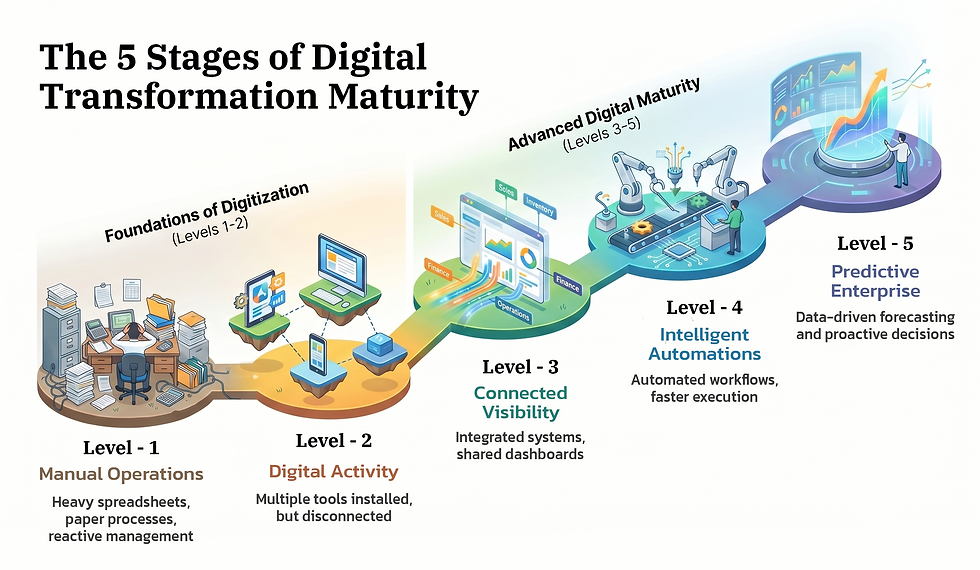
Level 1: Manual Operations
At this stage, the business depends heavily on people and spreadsheets.
What it looks like:
Reports created manually
Inventory tracked offline
Follow-ups depend on memory
Limited real-time visibility
Risk:
Growth increases workload faster than capacity.
Priority Move:
Digitize critical workflows first.
Level 2: Digital Activity
This is where many SMEs currently operate. Systems exist, but they function independently.
CRM is separate from finance.Inventory data sits in ERP.Marketing tools are isolated.
What it looks like:
Duplicate data entry
Teams exporting data into Excel
Delayed reporting
Decisions based on partial information
Risk:
Technology spending rises, but outcomes do not.
Priority Move:
Focus on integration before buying more tools.
Level 3: Connected Visibility
This is where meaningful progress begins. Systems start sharing information. Leadership gains a clearer view of operations.
What it looks like:
Shared dashboards
Real-time KPIs
Faster reporting cycles
Better cross-functional alignment
Business Impact:
Revenue opportunities become easier to spot.
Operational waste becomes visible.
Priority Move:
Use visibility to redesign weak processes.
Level 4: Intelligent Automation
Once visibility improves, automation creates leverage.
What it looks like:
Automated approvals
Lead routing workflows
Inventory alerts
Auto-generated reports
According to McKinsey & Company, automation can significantly improve productivity and reduce repetitive administrative work.
Business Impact:
• Cost ↓• Speed ↑• Productivity ↑
Priority Move:
Automate repetitive tasks with the highest time cost first.
Level 5: Predictive Enterprise
This is advanced maturity. The business uses data not only to understand the past but to anticipate the future.
What it looks like:
Demand forecasting
Predictive maintenance
Revenue trend modeling
Capacity planning based on signals
Business Impact:
Faster strategic decisions
Better resource allocation
Stronger competitiveness
Priority Move:
Continuously optimize decisions using data.
Quick Self-Assessment for SME Leaders
Ask these five questions:
Are reports real-time or delayed?
Do systems share data automatically?
How much work is still manual?
Can we identify issues before they escalate?
Are decisions based on signals or assumptions?
Your answers often reveal your maturity level.
Where Most SMEs Get Stuck
Many businesses move from Level 1 to Level 2 and stop there. They adopt tools but not transformation. This creates a dangerous illusion of progress.
Software exists.
But friction remains.
That is why digital maturity should be measured by outcomes, not installations.
The Core Insight
Digital maturity is not a technology milestone. It is an operational capability. The businesses that scale efficiently are rarely the ones with the most tools. They are the ones that use systems to create speed, clarity, and better decisions.
For many SMEs, the biggest challenge is not choosing new software. It is understanding what maturity level they are operating at and what should come next.
At i-Pangram, we help SMEs assess digital gaps, align systems, and move toward connected, intelligent operations.
If your business feels digitally active but not fully efficient, a focused maturity assessment can uncover the next growth opportunity.
References
OECD – SME digital productivity insights
McKinsey & Company – Automation and productivity research
Gartner – Data maturity and operational visibility
World Economic Forum – Digital competitiveness insights
Deloitte – Intelligent operations research
IDC – Digital maturity benchmarks
World Bank – SME competitiveness reports
Harvard Business Review – Data-driven decision making
OECD Going Digital reports
McKinsey Global Institute – Future of work studies



Comments